
Why this category commands high CPC
HR and payroll platforms tie directly to sensitive PII, tax filing liability, wage/hour compliance, and multi‑state complexity—driving enterprise‑grade evaluations and high downstream contract value, which increases advertiser bidding intensity in the U.S.. Buyers often evaluate all‑in‑one suites (HRIS + payroll + performance) or deeply integrated stacks, leading to competitive vendor comparisons and strong bottom‑of‑funnel intent.
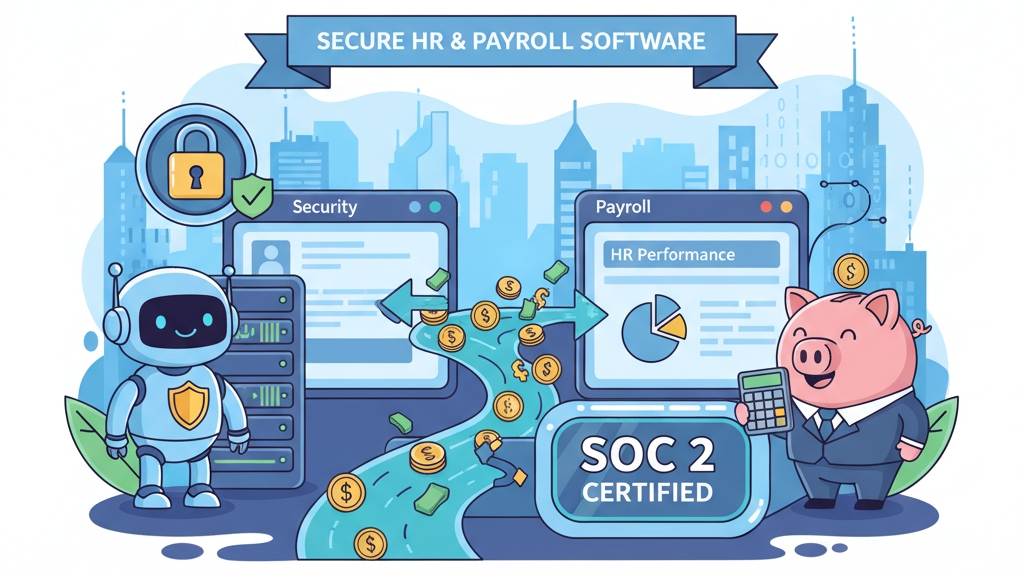
Core security requirements
- Data protection: Encryption in transit and at rest, role‑based access controls, SSO/MFA, audit logs, and granular permissions for HR, finance, and legal stakeholders are baseline for modern HR/payroll stacks.
- Operational controls: Change‑tracking, approval workflows, and automated error flags reduce risk during payroll runs and retro adjustments; visual verification before processing helps catch miscalculations early.
- Vendor posture: Preference for platforms with documented security programs, independent assessments, and strong integration security across time, benefits, and accounting systems.
SOC 2: what evaluators should verify
- Report type and scope: Confirm SOC 2 Type II coverage for core modules (HR, payroll, time, integrations), and review the control matrix for access management, change management, incident response, and data retention.
- Evidence depth: Examine testing periods, exceptions, and remediation; ensure third‑party sub‑processors are disclosed and governed via DPAs and flow‑down controls.
- Complementary user controls: Ensure your team can meet required customer responsibilities (e.g., user provisioning, periodic access reviews, secure SSO policies) to preserve the control environment.
State‑by‑state payroll complexity: U.S. realities
- Registration and tax nexus: Multi‑state employers must manage state registrations, unemployment rates, SIT/SUTA differences, and local taxes; systems should automate jurisdiction detection and filings for distributed teams.
- Wage and hour variability: Overtime rules, meal/rest breaks, final pay timing, PTO payout rules, and garnishments vary by state—platforms should encode state logic and provide alerts on rule conflicts before payroll runs.
- Local nuances: Paid sick leave, family leave, city payroll taxes, and rate changes require frequent updates and versioned rule engines to stay compliant as headcount expands into new states.
Performance review + payroll: why integration matters
- Review‑to‑reward workflows: Merit cycles, bonus calculations, and variable pay tied to performance require accurate integrations between reviews, compensation planning, and payroll calculation engines.
- Auditability: Linkage between review outcomes, approvals, and pay changes must be traceable for HR/finance audits and to substantiate pay equity and compliance programs.
- Employee trust and retention: Accurate, timely reflection of performance‑linked pay boosts engagement and reduces disputes; systems with clear change tracking improve transparency.
Must‑have features checklist
- Compliance engine: State/local tax updates, automatic filings, W‑2/1099 prep, multi‑state withholding, and garnishment handling with audit trails.
- Controls and visibility: Pre‑payroll change review, retro pay calculators, pro‑rations for mid‑cycle changes, and exception flagging for anomalies.
- Security and identity: SSO/MFA, RBAC down to field‑level where needed, IP/device controls, and export governance for PII.
- Performance alignment: Goals, reviews, 9‑box or competencies, calibration tools, and direct feed into compensation cycles and payroll.
Vendor landscape signals to assess
- All‑in‑one vs. best‑of‑breed: Suites can reduce sync errors and offer visual payroll change tracking; best‑of‑breed may win on depth for complex orgs—evaluate integration reliability and API coverage either way.
- Scalability: Confirm support for multi‑entity, multiple pay frequencies, union rules, and hourly/shift differentials for larger or diversified teams.
- Implementation and support: Prioritize vendors with proven onboarding, U.S. state tax expertise, and responsive support for filing issues or edge case corrections.
Evaluation framework (RFP prompts)
- Security and SOC 2: Request latest SOC 2 Type II, pen‑test summaries, sub‑processor list, data residency, and backup/DR RTO/RPO targets.
- Payroll compliance: Ask for supported states/localities list, filing automation details, amendment processes, and SLAs for tax notices.
- Performance‑comp linkage: Validate how reviews update merit/bonus, approval workflows, audit logs, and rollback paths for corrections.
Cost and ROI levers
- Total cost drivers: Per‑employee per‑month licensing, add‑ons (global payroll, benefits, time), implementation, and premium support tiers; consolidated suites may lower data sync and error‑correction costs.
- Savings levers: Error prevention (pre‑run flags, visual diffs), fewer manual entries, reduced tax notices, and faster cycle times produce tangible ROI, particularly for multi‑state teams.
Actionable buyer checklist
- Require SOC 2 Type II and SSO/MFA; run an access review pilot before signing.
- Test multi‑state scenarios: new state onboarding, rate changes, city tax additions, and retro corrections in a sandbox.
- Simulate a merit cycle: push performance outcomes into comp and confirm accurate payroll impacts with audit‑ready logs.